Pest Control
Find the cause, then treat the place it starts
Ants, roaches, spiders, termites, fleas, carpenter ants and carpenter beetles, bedbugs, wasps, bees, mosquitoes, centipedes, Indian meal moth, ticks and fruit flies.
Chapter 01
The inspection is not a formality
Every treatment here starts with a full, detailed inspection of the property, and the reason is that the insect you can see is rarely where the problem lives. Ants on a kitchen counter are a foraging trail, and the trail leads back to a nest that is often outside the wall entirely. Spraying the counter kills the scouts and changes nothing about next week.
So the inspection looks for three things: which pest it actually is, what is sustaining it, and how it is getting in. Carpenter ants and carpenter beetles in particular are worth identifying correctly, because they are not eating your food, they are excavating damp structural wood, and the real finding is usually a moisture problem somewhere behind them.
An infrared reading against a wall or a ceiling is part of how that gets narrowed down. Warmth where there should not be warmth, or damp where the surface should be dry, tells you which cavity to open before anyone opens it.
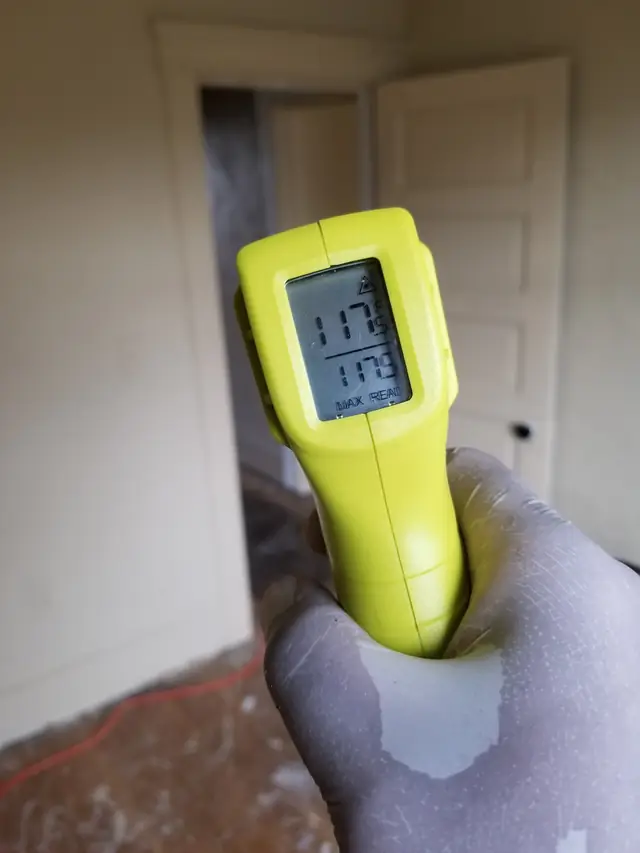
A technician holding an infrared thermometer against an interior surface during a property inspection
What gets treated, and the Cleveland calendar it runs on
The list is broad because the seasons here are: ants, roaches, spiders, termites, fleas, carpenter ants, carpenter beetles, bedbugs, wasps, bees, mosquitoes, centipedes, Indian meal moth, ticks and fruit flies, among others. Spring brings the ant calls, and one Beachwood area customer has now called two straight springs for two different species of ant, which is exactly how this trade actually behaves.
Summer moves it outdoors: wasps and bees at the soffit line, mosquitoes in standing water, and ticks around the perimeter of a property where the lawn meets longer growth. One customer had bees, ticks and stink bugs treated around the exterior of the house on a single visit, which is more typical than treating any one of them alone.
Bees are worth a separate note. A honey bee colony in a wall is a removal problem rather than a spraying problem, and it is handled with the same humane instinct the wildlife side of this business runs on.
Chapter 03
One visit, or a plan that stays ahead of it
Most problems are settled in one treatment, and that is genuinely the goal. A customer who wrote in about a repeat ant invasion made the point that mattered most to him: he did not want a corporation with a heavy handed subscription push, he wanted the ants knocked out in one shot by someone local he could speak to directly.
For properties that cannot afford to find out, monthly, quarterly, semi-annual and annual plans are available for residential and commercial customers. Restaurants, rental property and food storage are the usual reason, and Indian meal moth and fruit flies in particular are far cheaper to keep out than to clear.
Catch A Critter is licensed and insured and has worked out of 23500 Mercantile Rd in Beachwood since 2005. If the inspection turns up an animal rather than an insect, the same team handles that too, on the same visit.
Catch A Critter. Licensed and insured. Call (216) 323-2045, any hour.