Wildlife Removal
Humane wildlife removal, then the gap it used
Rats, mice, raccoons, skunks, moles, chipmunks, bats, birds and opossums, removed alive by trained technicians across Cuyahoga, Lake and Geauga Counties.
Chapter 01
What you are actually hearing
Almost nobody calls having seen the animal. They call because of a sound, and the sound is the best evidence there is. Heavy, deliberate dragging overhead in the evening is usually a raccoon, and in spring it is usually a female who has chosen your attic as a place to have kits. Fast scratching that starts around dusk and runs along one line is more often mice following a joist. A scuffle inside a wall cavity that stops when you knock is frequently a bird or a bat that dropped in and cannot climb back out.
That distinction matters more than it sounds, because the removal methods are not interchangeable. Setting for a raccoon when the problem is a squirrel colony wastes a night and teaches every animal in the roof where the traps are. So the first visit is an inspection of the property, not a delivery of equipment: which animal, how many, where they are entering, and whether there are young that cannot yet leave on their own.
It is also why the Beachwood office answers at 2am on (216) 323-2045. A bat circling a bedroom or a bird loose in a chimney flue is not a problem that improves by morning, and the household usually cannot sleep until it is out.
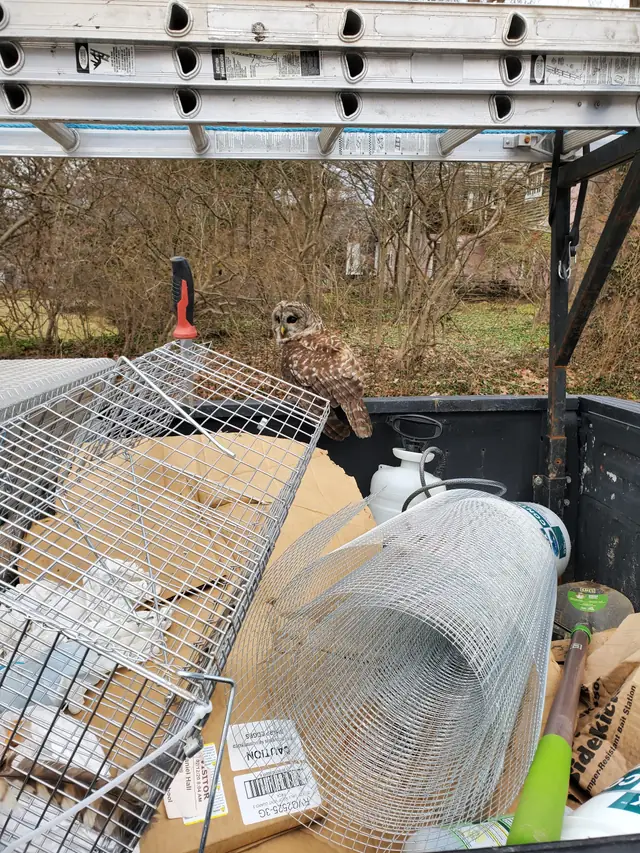
A barn owl in the open bed of the Catch A Critter truck beside traps and rolled exclusion mesh
Humane, and what that word has to mean
Only safe and humane removal methods are used here. In practice that means the animal leaves the building alive, and it means the timing respects the fact that a mother separated from a litter sealed inside a wall is both a cruelty and, within a week, a far worse problem than the one you called about.
So a job in the middle of denning season is sequenced rather than rushed. The young are located and removed with the adult, and the exclusion goes on afterwards, not before. A one way door fitted to an active entry lets an animal out and will not let it back in, but it is only honest to fit one once you are confident nothing is still inside that cannot use it.
Every technician working these calls is trained on that sequence. The reviews that mention a bird taken out of a house in under five minutes, or a job handled quietly enough not to wake a sleeping child, are describing the same discipline applied to a smaller problem.
Chapter 03
Why the last step is the one that lasts
A removal that ends when the truck leaves is a removal you will pay for again. The roof vent, the lifted ridge line, the uncapped chimney or the rotted soffit corner that let the animal in is still there, and it is still just as attractive to the next one. Greater Cleveland has a healthy raccoon, skunk and bat population, and they are all looking for the same warm, dry, defensible space.
So the work finishes at the building. Entry points are blocked and sealed, chimney caps are fitted where the flue is the route, and the contaminated material left behind is cleaned out and treated rather than left in the insulation. That last part is a service in its own right, and it is covered on the clean up and sanitation page.
Catch A Critter has been doing this from the Beachwood office since 2005, across Cuyahoga, Lake and Geauga Counties, for both homes and commercial properties. Licensed and insured, and independent rather than a franchise, which is why the person who inspects your roofline is usually the person who comes back to close it.
Catch A Critter. Licensed and insured. Call (216) 323-2045, any hour.