After the animal is gone: what is left in the insulation
It is a bacterial load sitting directly above rooms that people sleep in, and because it is out of sight, it is the step most often skipped.
September 15, 2026 · 3 min read
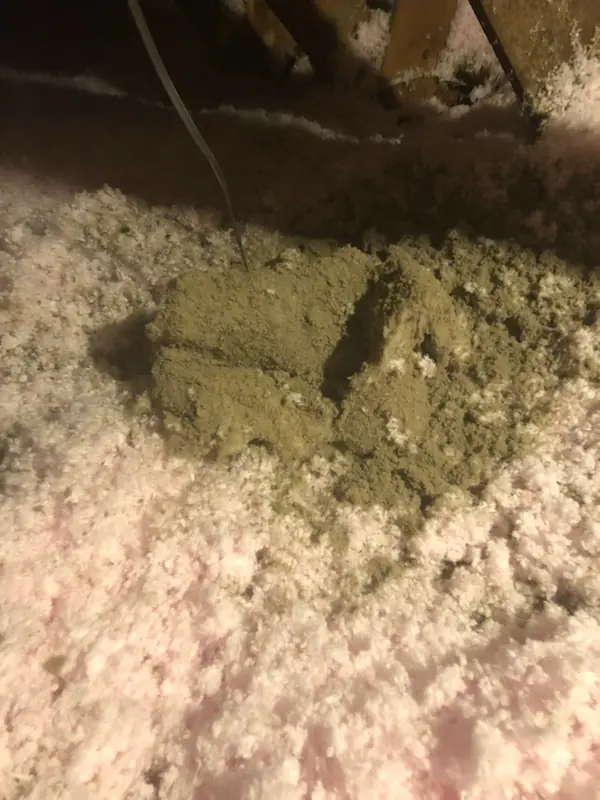
The removal gets the attention because it is the dramatic part. Something was in the house and now it is not. The house goes quiet, everyone relaxes, and the question of what the animal left behind gets deferred, usually indefinitely.
That deferral is understandable. It is dark up there, nobody wants to look, and the problem is not visible from any room in the house. It is also the step that most reliably comes back.
What a season of occupancy actually leaves
An animal that lived in a roof space for several months was doing everything there, not just sleeping. That means accumulated feces and urine, nesting material pulled together from insulation and whatever else was available, food waste carried in, and in some cases the remains of young that did not survive.
Insulation is the worst of it, because it is absorbent. Urine does not sit on the surface of loose fill or batt insulation, it soaks in and stays, and the material continues to hold and release that contamination long after the source has gone. Turning it over or raking it flat does nothing except redistribute it.
Compounding this, the smell itself is an invitation. Scent marking is how these animals communicate that a space is viable, and a roof space that still smells strongly of a previous occupant is meaningfully more attractive to the next one passing along the roof line.
Why this counts as a health matter
Without getting lurid about it, animal droppings in an enclosed roof space are a genuine bacterial load, and that space is not sealed off from the rest of the house. Air moves. Light fittings, hatches, and gaps around pipework all connect the roof void to the rooms below, and whatever is dry and disturbed up there can travel.
It matters most in a household where somebody already has a respiratory complaint, and that is the situation where clearing the air as well as the surfaces is worth doing rather than optional.
What proper remediation involves
Done properly this is a three part job, and each part is doing something the others do not.
- Physical removal of feces, nesting material and food waste from the space
- Removal of contaminated insulation, taken out rather than turned over
- Treatment of the affected areas to kill the hazardous bacteria left behind
- Where warranted, treatment of the home's air to clear harmful particles
- Sealing of the entry points afterwards so the whole sequence is not repeated
The order is not arbitrary. Treating surfaces before the material is out is treating the top of a pile. Sealing before cleaning leaves the scent marking in place, which undermines the exclusion work you just paid for.
The clean up usually tells you where the gap is
There is a practical benefit to doing this stage carefully that has nothing to do with hygiene. The distribution of the mess is a map.
Droppings concentrated along one run of joists are showing you the route the animal travelled, and that run almost always terminates at the way in. Nesting material heaped in one bay narrows down where it was actually living rather than where it was passing through. A technician who has cleaned the space knows the building better at the end of it than at the beginning, and the sealing work that follows is more accurate as a result.
Commercial properties have the same problem with a different clock
For a business the calculation is rarely about comfort. It is about health inspection, about reputation, and about the fact that a contaminated roof or service void above a food area is a finding rather than an inconvenience. The entry point also tends to be different, more often a roof unit, a service penetration or a loading area than a domestic chimney.
The work itself is the same, and it is available to commercial customers on the same monthly, quarterly, semi-annual and annual basis as pest treatment.
If somebody else did the removal
This is a common call and there is nothing awkward about it. Plenty of people have had an animal trapped and taken away by an operator who never went back into the roof space, and have then spent a year wondering about the smell in the upstairs hall.
Catch A Critter handles that as a job in its own right, across Cuyahoga, Lake and Geauga Counties, from the Beachwood office it has worked out of since 2005. Licensed and insured, and reachable at any hour on (216) 323-2045.
Catch A Critter, (216) 323-2045
Call (216) 323-2045More articles
What the noise in your attic is telling you
Almost nobody calls having seen the animal. They call because of a sound, and the sound is usually the best evidence there is.
Why sealing matters more than trapping
An attic was never the animal's idea. It was a gap at a roof vent, a lifted ridge line, or an uncapped chimney.