What the noise in your attic is telling you
Almost nobody calls having seen the animal. They call because of a sound, and the sound is usually the best evidence there is.
September 15, 2026 · 4 min read
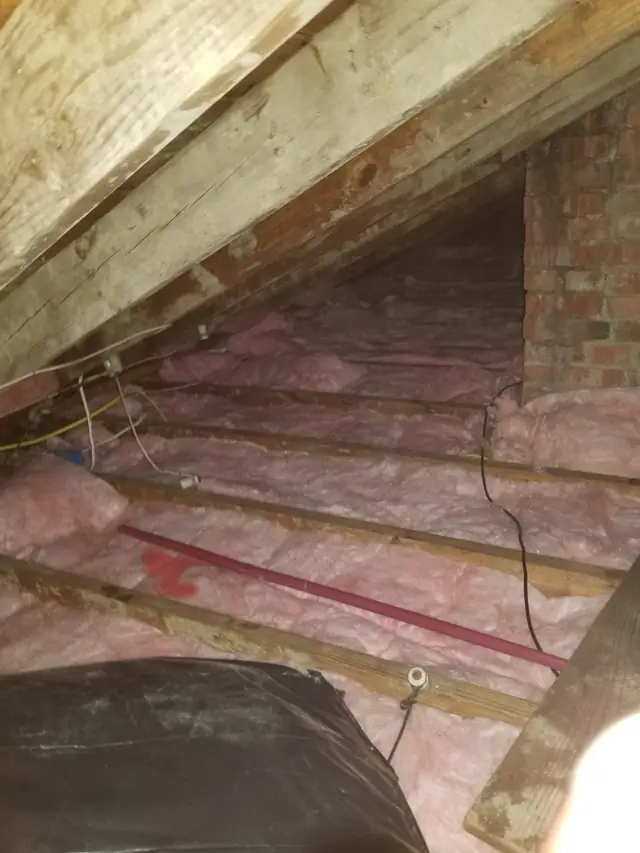
The first thing worth knowing is that you are not being paranoid and you are not imagining the pattern. Roof spaces carry sound strangely, and a mouse running along a joist directly above a bedroom ceiling can sound like something much larger than a mouse. But the pattern itself is real information, and if you can describe it accurately on the phone, a technician can usually tell you what it probably is before anyone is scheduled.
Here is roughly how that reading works, based on the calls that come in across Cuyahoga, Lake and Geauga Counties.
Heavy, slow, deliberate, and usually in the evening
If the sound is weighty enough that you instinctively look up, and if it comes in bursts of dragging or thumping rather than a constant patter, the usual answer is a raccoon. They are big animals, they are not remotely discreet, and they tend to move at dusk and again before dawn because that is when they are coming and going.
In spring, a raccoon in a roof space is very often a female who has chosen your attic as somewhere safe to have kits. That changes the job considerably. You may hear a second register of noise underneath the heavy movement, a sort of chittering or crying, and that is the single most useful detail you can pass on, because it means there are young present that cannot leave on their own yet.
Fast, light, and following a line
Rapid scratching or scurrying that seems to travel along a straight run, and that starts up shortly after dark, is much more likely to be mice or rats. They follow structure. The straightness you are hearing is a joist or a top plate, because rodents prefer to move with a wall on one side of them rather than out in the open.
Squirrels produce a similar lightness but a very different clock. They are daytime animals, so if the activity is loudest mid morning and goes quiet in the evening, that points at squirrels rather than rodents, and it usually points at a gable vent or a lifted section of roof edge as the way in.
A scuffle inside a wall that stops when you knock
This is the one that worries people most, and it is often the one with the simplest ending. A flapping or scrabbling noise confined to a single spot inside a wall cavity or behind a fireplace is frequently a bird that has come down a chimney flue, or a bat that has dropped into a space it cannot climb back out of.
Neither animal is in there by choice, and neither is doing structural damage while it waits. What they cannot do is get themselves out. A bird down a chimney into a closed fireplace can be removed in a matter of minutes by somebody who knows how to open the space without letting it loose into the room, and that is genuinely how most of those calls end.
Why the guess matters before anything is set
It would be convenient if removal equipment were interchangeable, and it is not. Setting for a raccoon when the actual occupant is a squirrel colony wastes a night, and worse, it teaches every animal in that roof where the unfamiliar object is. Animals that have been through one badly targeted attempt are measurably harder to catch on the second.
That is why every job here opens with an inspection of the property rather than a delivery of traps. Which animal, how many, where they are entering, and whether there are young involved. Those four answers determine the method, the sequence and the timing, and none of them can be guessed reliably from the driveway.
What you can safely check yourself
You do not need to go into the roof space, and on balance you should not, particularly if there is any chance of a bat or of accumulated droppings. But there are things worth noting from the ground that will speed up the visit considerably.
- What time of day the noise is loudest, and whether that is consistent
- Whether it is one area of ceiling or moves across several rooms
- Whether you have heard anything that sounds like more than one animal
- Any staining, smell, or flies appearing at a ceiling or light fitting
- Anything visible from outside: a lifted roof edge, a damaged vent, an uncapped chimney
That last point is worth dwelling on, because it is the part most people never think to look at. Whatever is up there came in somewhere, and from the ground with a decent pair of eyes you can often spot the gap before anyone is on a ladder.
When it is not something to sleep on
Most attic noise can wait until morning. Two situations really cannot. The first is a bat in living space rather than in the roof, because that becomes a health question rather than a nuisance one and it needs handling properly rather than with a tea towel. The second is any sound that suggests an animal is trapped somewhere it cannot get out of, including inside a wall cavity, because that resolves itself badly and quickly.
Catch A Critter answers the phone 24 hours a day on (216) 323-2045 for exactly those calls. If it is two in the morning and something is loose in the house, that is a reasonable hour to ring.
Catch A Critter, (216) 323-2045
Call (216) 323-2045More articles
Why sealing matters more than trapping
An attic was never the animal's idea. It was a gap at a roof vent, a lifted ridge line, or an uncapped chimney.
Bees, wasps and the soffit line in a Cleveland summer
By July the calls stop being about attics and start being about the eaves.