Ant season in Northeast Ohio, and why they came back different
Spraying the trail kills the scouts and changes nothing about next week.
September 15, 2026 · 4 min read
Ants are the most common spring call this business takes, and they are also the problem people most often try to solve themselves first. That is entirely reasonable. They are small, they are visible, and the shops are full of things that kill them on contact.
The difficulty is that the ants you can see are the least important ants in the equation.
What a trail on the counter actually is
A line of ants moving across a kitchen surface is a foraging trail, and the insects on it are workers. They are a tiny fraction of the colony and they are entirely replaceable. The colony itself, with the queen that is producing all of them, is somewhere else, and in a great many cases it is not even inside the building.
Kill the trail and the colony notices nothing except that one food route stopped producing. Within days there will be a new trail, quite possibly entering at a different point, and the homeowner concludes that the ants are getting smarter. They are not. They were never the target.
Treating the cause rather than the symptom means finding where the colony is, understanding what is sustaining it, and working back along the route. That is the reason every treatment here begins with a full inspection of the property rather than with a sprayer.
Carpenter ants are a different conversation
Of all the ant species that turn up in Northeast Ohio homes, carpenter ants are the ones worth identifying correctly, because they are not really a food problem at all.
Carpenter ants do not eat wood. They excavate it to nest in, and crucially they strongly prefer wood that is already damp or beginning to decay. That preference makes them one of the most useful indicators in this entire trade. A carpenter ant problem is very often a moisture problem wearing a disguise.
So when they turn up, the questions that follow are about the building: a gutter that has been overflowing against a fascia, a roof leak that was patched but never dried out, a sill plate behind a planter, a window frame that has been holding water for a couple of seasons. Treat the ants and ignore that, and you have bought yourself a season.
Carpenter beetles sit in a similar category, and they are worth separating from carpenter ants during the inspection rather than after.
Why the infrared reading
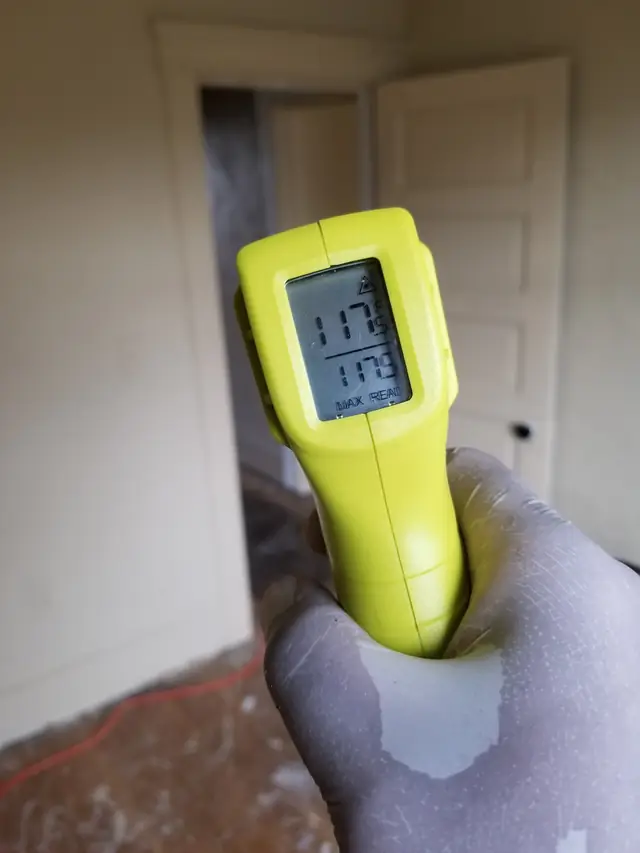
A thermal reading against a wall or ceiling is not theatre and it is not a gadget for the sake of it. It is a way of narrowing down which cavity to open before anyone opens it.
Damp behaves differently to dry material thermally, and an area of unexpected cool where a surface should be at room temperature is a strong hint that there is moisture behind it. In a carpenter ant investigation that is frequently how the actual nest location is found, and it means the difference between one small, deliberate access point and a wall opened up on guesswork.
A second spring, a second species
One customer in this service area called two springs running for what looked like the same problem and turned out to be two different kinds of ant. That is not unusual and it is not a sign that the first treatment failed.
Different ant species want different things. Some are after grease, some are after sugar, some are nesting in soil against the foundation, some are up in a damp roof edge. A property that is attractive to one is not necessarily attractive to another for the same reason, and a successful treatment of the first tells you nothing about the second except that the building has more than one soft spot.
It also means that correct identification matters every single time, rather than assuming this year is a repeat of last year.
What helps before the visit
- Leave one trail intact if you can stand to, because a live trail is the fastest route to the nest
- Note where they are entering and at what time of day the traffic is heaviest
- Note whether they are going for sweet things, greasy things, or neither
- Look for small piles of what looks like sawdust, which points at carpenter ants
- Check for any long standing damp, because that is frequently the real finding
One visit, or a plan
Most ant problems are settled in a single treatment, and that is genuinely the intention rather than a first step in a subscription. A customer who wrote about a repeat ant invasion made the point plainly: he wanted the problem knocked out in one go by someone local he could speak to directly, not a heavy handed recurring contract.
Where a property does need to stay ahead of it, monthly, quarterly, semi-annual and annual plans exist for residential and commercial customers, and restaurants and food storage are the usual reason. Catch A Critter is licensed and insured, has worked from Beachwood since 2005, and answers at any hour on (216) 323-2045.
Catch A Critter, (216) 323-2045
Call (216) 323-2045More articles
What the noise in your attic is telling you
Almost nobody calls having seen the animal. They call because of a sound, and the sound is usually the best evidence there is.
Why sealing matters more than trapping
An attic was never the animal's idea. It was a gap at a roof vent, a lifted ridge line, or an uncapped chimney.